

This website uses cookie or similar technologies, to enhance your browsing experience and provide personalised recommendations. By continuing to use our website, you agree to our privacy policy. You can adjust cookie preferences in Cookie Settings.


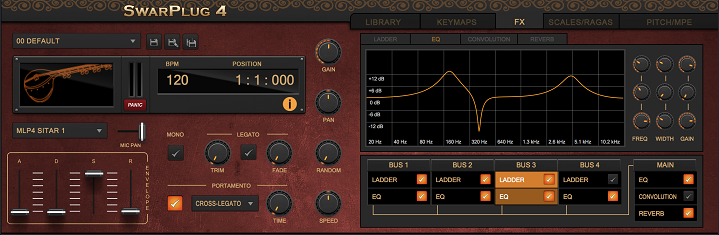
The SwarPlug synth plugin includes Tile Tarang and over 100 other perfectly sampled
virtual Indian instruments. It can be loaded in most VST, Audio Units and AAX compatible DAWs
(Digital Audio Workstations) like Cubase, Logic, Ableton Live, Protools, FL Studio etc... It also
comes with lots of ready-made MIDI loops for each instrument.
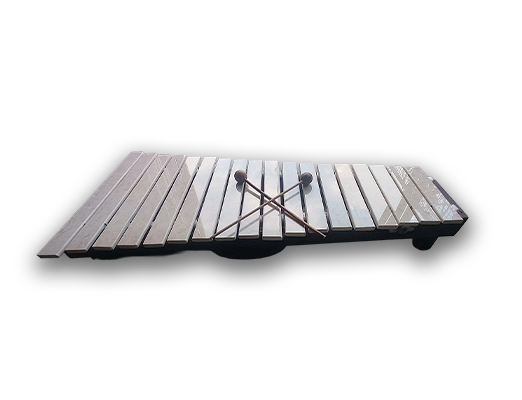
The Tile Tarang takes its name from tarang, meaning waves, a term shared with other Indian melodic percussion instruments such as Jal Tarang and Tabla Tarang, reflecting a common naming tradition for instruments that produce a series of melodic tones. Like the Glass Tarang, it is a modern adaptation of the Western vibraphone, here reimagined using ceramic tile in place of metal or glass.
A standard vibraphone consists of a set of tuned metal bars, arranged like a piano keyboard, that are struck with mallets and suspended over resonator tubes, often with a motor-driven fan mechanism that creates the instrument's signature vibrato. In the Tile Tarang, the metal bars are replaced with flat, rectangular pieces of ceramic tile, each cut to a specific length and thickness to produce a particular pitch when struck. Ceramic tile is a dense, rigid material that responds to striking with a clear, percussive attack, generally producing a tone that sits somewhere between the brightness of glass and the warmth of wood, with less sustain than metal but a distinctive clean, knock-like clarity.
Constructing the instrument requires careful attention to the thickness, length, and density of each tile piece, since these determine both the pitch and the resonance of the tone produced. Denser, well-fired tiles are typically favored, as they hold a stable pitch and are less prone to cracking under repeated striking than more porous ceramics. As with glass or metal versions of the instrument, the tile pieces are usually mounted on rubber or felt padding at their nodal points, allowing them to vibrate freely while staying securely fixed in place, and may be suspended over resonating chambers to help project and sustain the sound. Mallets of varying hardness can be used to shift the tone between softer, more muted strikes and sharper, brighter ones.
Because ceramic tile instruments of this kind are not standardized or mass-produced, the Tile Tarang exists as a niche, largely handmade instrument rather than part of an established classical tradition. Like the Glass Tarang, it tends to appear in contemporary, experimental, or fusion contexts, where builders and musicians explore how everyday or unconventional materials can be adapted into tuned percussion instruments.