
This website uses cookie or similar technologies, to enhance your browsing experience and provide personalised recommendations. By continuing to use our website, you agree to our privacy policy. You can adjust cookie preferences in Cookie Settings.


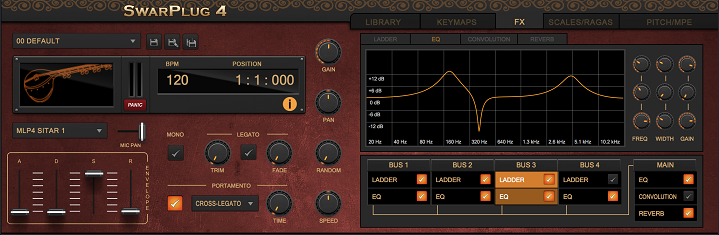
The SwarPlug synth plugin includes Bell Tree and over 100 other perfectly sampled
virtual Indian instruments. It can be loaded in most VST, Audio Units and AAX compatible DAWs
(Digital Audio Workstations) like Cubase, Logic, Ableton Live, Protools, FL Studio etc... It also
comes with lots of ready-made MIDI loops for each instrument.
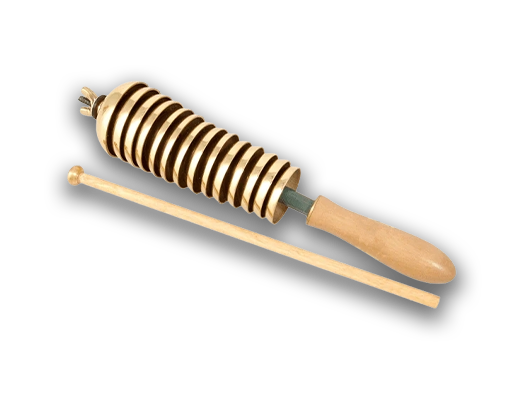
The Bell Tree, sometimes marketed as the "Chinese bell tree" despite likely European or American origins, is a percussion idiophone used primarily as an auxiliary instrument for musical color rather than melody. It is typically used in percussion ensemble works, orchestral and band compositions, and is especially common in film, television, and commercial soundtrack music.
The instrument consists of a series of inverted, bowl-shaped metal bells, most often made of brass, arranged vertically on a central rod. The bells are graduated in size and nested with small spacers keeping them separated, with the smallest bell placed at the bottom and the largest at the top. The number of bells can vary considerably depending on the model, typically ranging from around 8 to 28. Each bell is threaded onto the rod through a hole drilled at its apex, a point chosen because it is the acoustically least active part of the bell and therefore interferes least with its ability to resonate. Organology
The Bell Tree is played by sliding a mallet, drumstick, or metal rod down the length of the stacked bells, causing them to sound in rapid succession. This produces a shimmering sound that continues for a few seconds while gradually decreasing in intensity. The larger bells at the top produce a reasonably definite pitch, but the pitches of the smaller bells become progressively less distinct, and the full set of bells is not tuned to any formal musical scale, instead featuring numerous microtonal intervals between adjacent bells. This inexactness is part of what gives the instrument its effect: when swept quickly, the slight irregularities in pitch blend together into a fuller, more shimmering glissando rather than a clean scale.
The modern form of the instrument is often associated with mid-20th-century percussion practice; some sources credit sound effects specialist Carrol Bratman with refining the design in the 1950s, helping popularize it in contemporary recording work. It gained further visibility in the 1970s through jazz fusion, notably in recordings by Chick Corea's Return to Forever, and has since been used by a range of rock and popular musicians looking for a bright, ethereal texture. Today, the Bell Tree remains most common in film and television scoring and studio recording, where its cascading shimmer is used to underscore magical, dramatic, or transitional moments, though it also appears occasionally in orchestral and percussion ensemble literature. It is worth noting that the Bell Tree is frequently confused with a related but distinct instrument, the mark tree (also called bar chimes), which uses hanging metal cylinders rather than nested bowl-shaped bells and produces an inharmonic, rather than a graduated bell-like, sound.